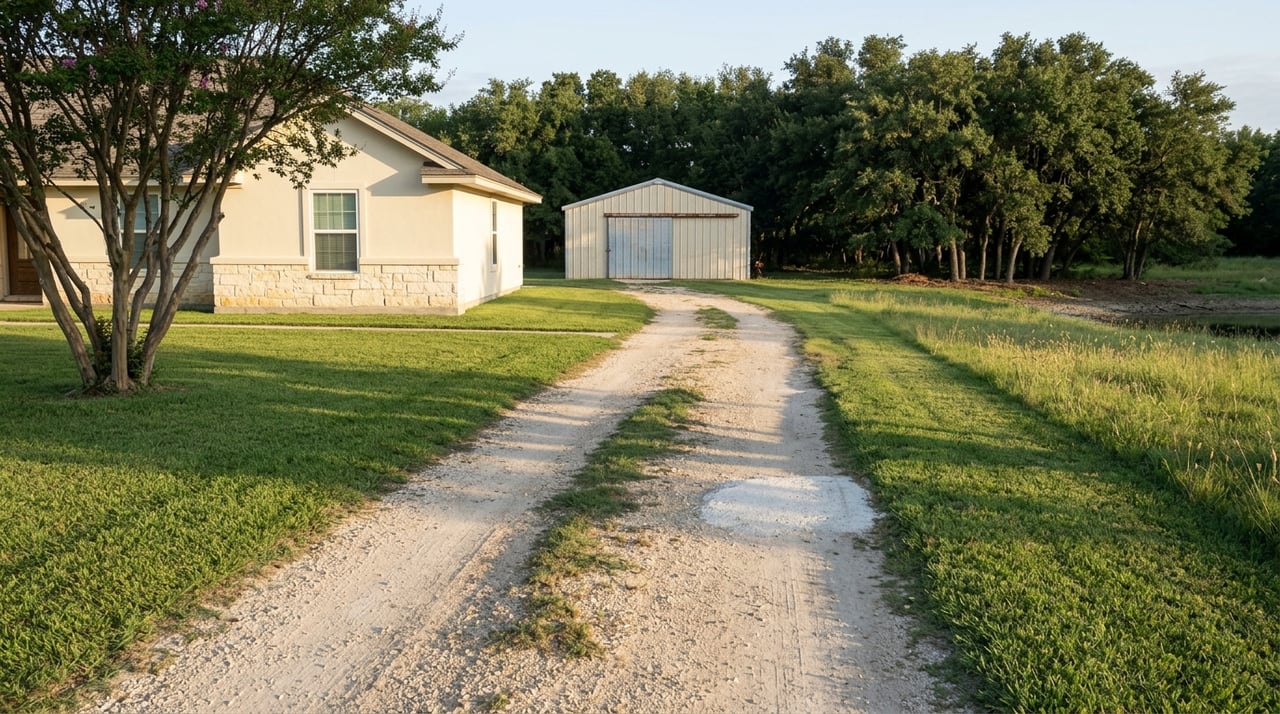
Here's the number that trips up buyers on Argyle acreage: a $2 million tract can show an annual tax bill under $400. Not because the county made a mistake. Because the land is appraised on what it produces, not what it's worth. A buyer who prices their carrying cost off that number is pricing off a condition, not a fact, and the condition can end the moment they close.
That's the part the MLS sheet doesn't say. The agricultural valuation on a piece of Argyle land isn't a discount that rides along with the deed. It's a special appraisal tied to how the land is used, and Denton Central Appraisal District decides whether it survives a change of ownership, not the seller and not the listing agent. Get that backwards and the surprise doesn't show up at closing. It shows up eighteen months later, in an envelope from the county, with a rollback bill attached.
What the Rollback Actually Costs
Texas Tax Code Section 23.55 governs the mechanics. When qualifying agricultural use ends, the county recalculates what the land would have owed at full market value for the prior period and bills the difference. House Bill 1743, effective September 1, 2019, cut that look-back window from five years to three and lowered the annual interest charged on the recaptured amount from 7 percent to 5 percent. That's a real improvement over the pre-2019 rule, but the underlying gap between productivity value and market value in a place like Argyle is still large enough to matter, and the 5 percent interest still accrues on top of whatever the base recapture comes to.
Run the arithmetic on a stylized tract that mirrors what's actually listed in the area:
| Productivity Valuation | Market Valuation | |
|---|---|---|
| Assessed value | $16,000 | $2,000,000 |
| Annual tax at ~2.2% | $352 | $44,000 |
| Three-year rollback exposure | roughly $130,944 |
That $130,944 is the base recapture before interest, and it isn't a worst-case scenario. It's the current statute applied to a valuation gap that's common on Argyle-area land right now. Farmland listings in and around Argyle are currently averaging close to $200,000 an acre, and once you fold in the commercial-zoned tracts along I-35W, the blended average for all land listings near town climbs past $287,000 an acre. At that scale, the gap between what a seller pays under ag valuation and what a buyer would owe at market rate isn't a rounding error. It's the difference between a manageable holding cost and a bill that reshapes the deal.
Who Actually Pays This
Here's the part that catches people off guard: the tax lien attaches to the land on the date the use changes, and it follows the parcel until it's paid. Who's responsible for it is negotiable in the contract, but by default it lands on whoever owns the land when the qualifying use stops. In practice, that's almost always the buyer, not the seller who benefited from the low bill for years.
Think about the incentive that creates. A seller who has run cattle on a tract for a decade has every reason to advertise the tax line and none to volunteer how fragile it is. The buyer who plans to build a home, subdivide a portion, or simply let the land sit while they figure out their plans is the one who trips the wire, and the seller is three years and a closing away from any exposure. That asymmetry is exactly why getting a rollback allocation written into the contract, along with a seller representation about the land's use history, is one of the highest-leverage moves in a Denton County farm and ranch deal.
The valuation itself doesn't transfer automatically either. It's tied to use, not to the deed, which means a new owner has to file their own application with Denton CAD, generally by April 30 of the year following purchase, using Comptroller Form 50-129. Denton CAD also requires the land to show a five-of-the-past-seven-years history of qualifying agricultural use, so a seller's documentation, lease agreements, hay receipts, livestock records, matters as much as a buyer's intentions going in.
Not Every Acre in Argyle Carries This Risk
Worth separating out: not all Argyle acreage is working land facing this exposure. Redbird Ridge, a gated community of just 23 one-acre homesites with equestrian trails and no city taxes, and Eagle Ridge in nearby Bartonville, are platted for luxury homesites rather than agricultural production. Land in communities like these carries a different tax profile entirely, since there's no productivity valuation to lose in the first place. The rollback conversation belongs specifically to tracts currently carrying a 1-d-1 open-space appraisal, which is the bulk of what's marketed as "ag exempt" acreage around town, not to every large lot inside Argyle ISD.
The Town of Argyle's own low-density zoning and tree preservation rules also shape what a buyer is actually purchasing. Those ordinances are part of what keeps a neighbor from clear-cutting a lot line or dropping a denser development next door, and they factor into value independent of anything happening on the tax roll.
The Second System Buried in the Same Deal
Acreage in Argyle almost never comes with a city sewer connection. Most of it runs on an on-site sewage facility, and the aerobic systems common in the area come with their own maintenance obligations that a buyer inherits along with everything else. Denton County requires aerobic systems to be inspected three times a year by a licensed maintenance provider, and new installations carry a mandatory two-year initial maintenance contract. At sale, the outgoing owner is responsible for requesting that the OSSF permit transfer to the new owner, a step that's easy to miss in the rush to close.
Two companies with a track record in the county are worth knowing if a septic evaluation turns up questions: Texas Star Aerobic, based in Highland Village, has serviced more than 5,000 aerobic systems across the region over 40 years, and Acton Septic in Sanger has served Denton County customers since March 2000. For water, Argyle Water Supply Corporation serves much of the area, but on tracts of fifteen acres or more, a private well is often the more economical choice for irrigation and livestock, and it happens to double as documentation that supports an ag valuation if Denton CAD ever asks for proof of use.
Before the Option Period Ends
A few items are worth confirming while there's still time to renegotiate:
- Request the current 1-d-1 application on file with Denton CAD, along with any correspondence about the property's use history
- Confirm the five-of-seven-years qualifying use with dated records, not verbal assurance
- Get a rollback allocation and seller representation about use history written into the contract
- Ask whether the OSSF permit has been requested for transfer, and get the maintenance contract status in writing
- If the tract is fifteen acres or larger, ask whether a private well already exists or whether irrigation runs entirely on Argyle Water Supply Corp service
None of this is tax or legal advice. Denton Central Appraisal District, at 3911 Morse Street in Denton, makes the actual determination on valuation and rollback, and their agricultural information page is the place to verify current filing rules before writing an offer. For septic questions, Denton County Public Health's Environmental Health Division administers OSSF permitting, and the TCEQ's septic system guidance covers what a mortgage lender's evaluation will and won't catch.
A Few Questions That Come Up Often
Does selling ag-exempt land trigger rollback for the seller? Under the common 1-d-1 appraisal, simply selling doesn't trigger rollback on its own. The trigger is a change in how the land is used after the sale, which is why the exposure so often lands on the buyer rather than the seller.
Can I build a home on part of the tract and keep the rest in ag valuation? Generally yes, if the split is proportional and documented. Building a homesite on a few acres of a much larger tract typically triggers rollback only on that carved-out portion, provided the remainder continues in qualifying use and the CAD paperwork reflects the division.
How do I confirm a septic permit has actually transferred? Ask the seller for documentation that they requested the transfer with Denton County Public Health, and confirm directly with the county's Environmental Health office before closing rather than after.
Acreage deals in Argyle move on details that don't show up in a listing photo or a tax line. If you're weighing a purchase or preparing to sell a tract in this corridor, Betsy Daniel can walk through what the current valuation actually means for your specific parcel and what to put in writing before the option period runs out. Schedule a consultation to start that conversation.